

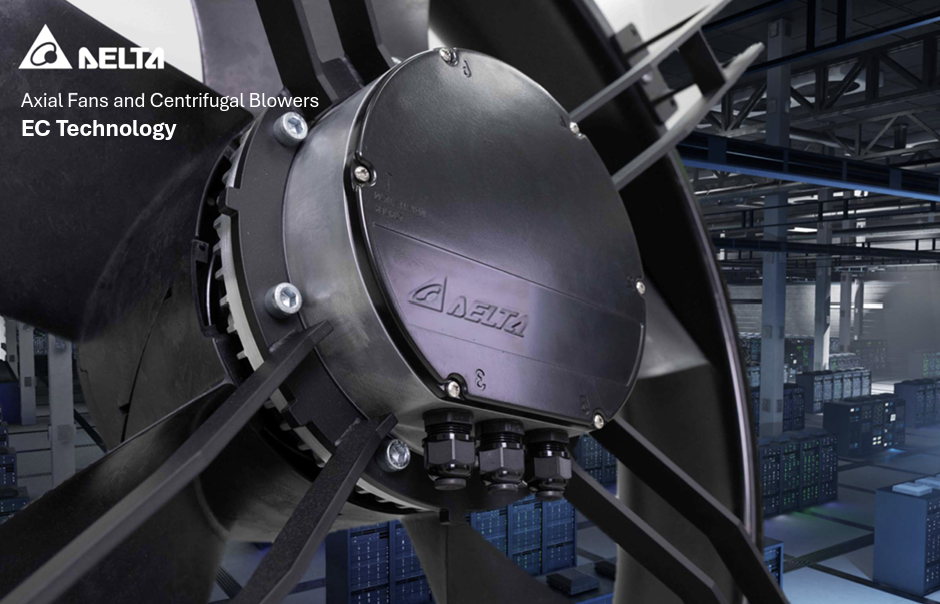
A fan selection starts with more than airflow
It’s easy to look at a fan application and start with one number: how much air needs to move?
That matters, but it’s only part of the selection.
The fan also has to work against the pressure in the system, fit the available space, integrate with the controls architecture, tolerate the operating environment, and deliver the reliability the application demands.
Consider a computer room air handling unit (CRAHU) in a data centre, an air handling unit (AHU) in a commercial building, or a fluid cooler or condenser in an industrial cooling system. Each has different airflow, pressure, control, and operating requirements.
BlueRock carries Delta Electronics’ full EC axial fan and centrifugal blower range, providing options for these and other HVAC, industrial, commercial, and data centre applications.
Drawing on Delta’s 2026 EC fan product brochure, here’s what to consider before specifying one.
What Delta’s EC technology brings to the application
The EC platform combines high-efficiency motor technology with aerodynamic fan and impeller designs to deliver controlled airflow while managing energy consumption, vibration, and noise.
Depending on the model, available features include:
- EC motor efficiencies in the IE4–IE5 range
- 0–10 V, PWM, and Modbus control options
- IP55 protection on applicable models
- Integrated over-temperature and over-voltage protection
- Functions such as reverse rotation, linear speed control, and safety modes
- Vibration sensing for real-time monitoring
- Aerodynamic impeller and stator designs that improve airflow and reduce vibration
For the person specifying the equipment, the important point isn’t simply that the fan has an efficient motor.
It’s that airflow can be controlled rather than treated as a fixed output. If an application doesn’t require full airflow all the time, precise speed control allows the system to respond to changing operating conditions.
Axial fan or centrifugal blower?
Axial fans and centrifugal blowers are suited to different combinations of airflow and static pressure.
EC axial fans are generally suited to applications requiring substantial airflow at comparatively lower static pressures. This makes them useful in HVAC equipment such as chillers, condensers, fluid coolers, and cooling towers, where moving large volumes of air is essential.
The axial range spans multiple diameters and configurations, with maximum efficiency of up to 61%.
EC centrifugal blowers can operate across higher pressure ranges, making them suitable for systems where air must move through greater resistance. These can include air handling units, filtration systems, and data centre cooling equipment such as CRAHUs.
The centrifugal blower range offers efficiency of up to 74%, along with low vibration and features designed for demanding HVAC, industrial, and data centre applications.
The takeaway isn’t that one is better than the other. It’s that the system curve matters.
Before selecting either, you need to understand both the required airflow and the resistance the fan will actually be working against.
Controls should be part of the selection, not an afterthought
Modern fan selection increasingly overlaps with the controls conversation.
The EC range supports control methods including 0–10 V, PWM, and Modbus. Depending on the application, these allow fan speed to respond to system demand rather than operating at one fixed point.
Depending on the model, additional functions include reverse rotation, linear speed control, safety modes, and over-temperature and over-voltage protection.
For systems that rely on a building management system (BMS), programmable logic controller (PLC), or another supervisory control platform, establish the control requirements before selecting the fan.
A fan can meet the airflow requirement on paper and still create unnecessary integration work if its available control methods don’t align with the rest of the system.
Don’t overlook the operating environment
A fan installed in a controlled mechanical room faces very different conditions from one operating outdoors or in an industrial environment.
Depending on the model, features designed for more demanding conditions include:
- IP55 environmental protection
- Operating temperatures from -25°C to 70°C
- Protection for environments with up to 95% relative humidity
- C3–C5 corrosion protection in accordance with ISO 12944
- Reverse rotation to help clear snow and dust
- Extended operating-life design
These considerations become particularly important for outdoor condensers, fluid coolers, cooling towers, and industrial ventilation applications.
The airflow requirement alone won’t tell you what the fan will be exposed to after installation. Temperature, moisture, corrosion, dust, and installation location should all be part of the selection conversation from the beginning.
Where these fans show up
EC axial fans and centrifugal blowers support a wide range of equipment and system designs.
In industrial and commercial applications, common examples include chillers, condensers, fluid coolers, cooling towers, air handling units, wall-mount air conditioners, photovoltaic inverters, wind turbines, and energy storage systems.
In data centre cooling, applications include fan arrays, AHUs, CRAHUs, in-row cooling equipment, rear-door heat exchangers, chillers, fluid coolers, condensers, and cooling towers.
Each application brings different requirements. A commercial AHU may need to accommodate changing building demand, while a CRAHU supporting critical data centre infrastructure may place greater emphasis on continuous operation, precise speed modulation, vibration monitoring, and control-system integration.
The EC range offers different configurations to meet these needs, but selecting the right fan still comes down to the operating requirements of the individual system.
What to confirm before you specify a fan
A product table can help narrow down the options, but it shouldn’t be the entire selection process.
Before specifying an axial fan or centrifugal blower, work through these seven questions.
1. What is the actual duty point?
Confirm both the required airflow and static pressure.
Selecting a fan based on maximum airflow alone can be misleading. It must deliver the required airflow against the resistance of the actual system.
2. What power is available?
The range includes different power ratings, voltages, and single- and three-phase configurations.
Make sure the electrical requirements match the equipment the fan will be installed in.
3. How will speed be controlled?
Determine whether the application requires 0–10 V, PWM, Modbus, or another control approach.
It’s much easier to resolve this during selection than during commissioning.
4. What environment will the fan operate in?
Consider temperature, humidity, dust, corrosion exposure, and whether the equipment will be installed indoors or outdoors.
Then check the environmental specifications of the particular model being considered.
5. How might system resistance change during operation?
Filters, coils, and changing operating conditions can affect system resistance. Consider the expected operating range and confirm that the selected fan can meet the system’s requirements beyond a single design point.
6. Is monitoring important?
For critical equipment, knowing what the fan is doing can be just as useful as controlling it.
Available vibration sensing and remote monitoring capabilities can help operators monitor equipment condition in applications where reliability is critical.
7. What happens after the fan is installed?
Access, serviceability, controls integration, and replacement requirements are easy to overlook during initial selection.
A fan that meets the technical specifications but creates problems during installation or maintenance may not be the right fit for the application.
It comes back to the application
Fans can look relatively simple on a specification sheet.
In practice, the right choice sits at the intersection of airflow, pressure, electrical requirements, controls, environment, and how the equipment will actually operate in the field.
With the full Delta EC axial fan and centrifugal blower range available through BlueRock, designers have options across HVAC, industrial, commercial, and data centre applications.
The next step is matching those options to the real system.
Talk it through with BlueRock
If you’re evaluating a fan application, share your operating conditions, airflow and pressure requirements, controls information, and whatever else you already know.
Our team can help you work through the application and narrow down the options before you get too far into the design.