

Liquid cooling depends on keeping coolant moving
As data centre rack densities increase, liquid cooling is taking on a larger role in managing the heat generated by AI and other high-performance computing infrastructure.
Cold plates move heat away from processors. Coolant Distribution Units (CDUs) help manage and isolate cooling loops. Heat exchangers transfer heat from one fluid circuit to another.
But none of that works unless the coolant keeps moving.
That is the job of the pump.
A pump has to move enough coolant through the system to carry heat away from the load while overcoming resistance through piping, cold plates, heat exchangers, filters, valves, fittings, and other components.
That makes pump selection more than a question of how many litres per minute a unit can move.
Flow, pressure, electrical supply, controls, physical integration, and how the cooling system will actually operate all need to be considered together.
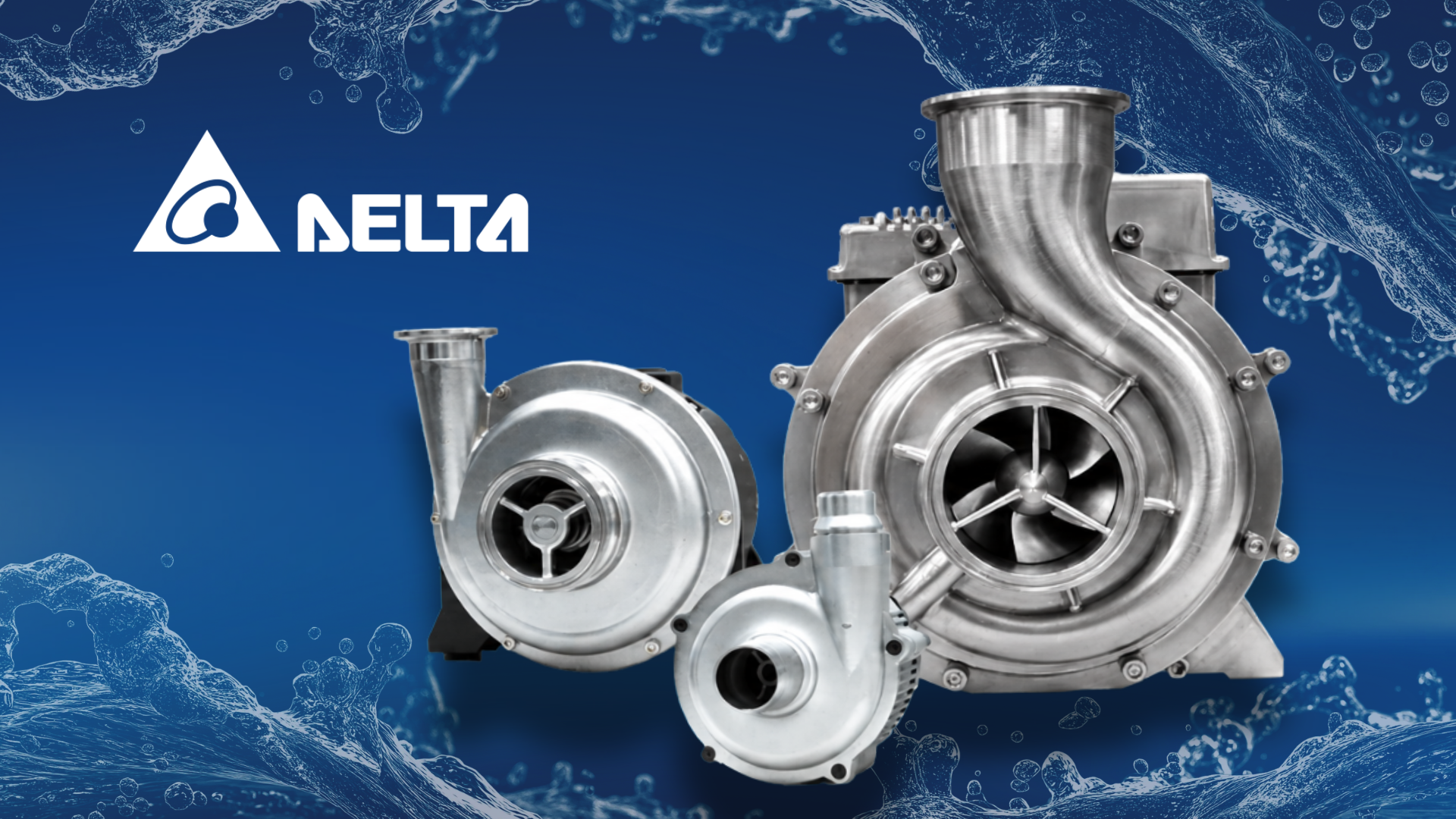
Delta Electronics’ electrical pump range includes lower-power 48 VDC pumps as well as higher-capacity EC and HVDC options designed for applications including data centres and AI servers.
Where the pump fits in the cooling loop
In a direct-to-chip liquid cooling system, coolant passes through cold plates attached to processors or other high-heat components.
As that coolant absorbs heat, it needs to circulate back through the cooling system so the heat can be transferred elsewhere.
The pump creates the flow that keeps that cycle moving.
The challenge is that every component in the loop creates resistance.
Longer piping runs, additional fittings, restrictive cold plates, filters, heat exchangers, and control valves all contribute to pressure loss.
The pump therefore has to do two things at the same time: deliver the required flow and generate enough pressure to overcome the resistance of the actual system.
That relationship is why the pump curve matters.
A maximum flow figure tells you what a pump can move under a particular condition. It does not automatically tell you how much flow the pump will deliver after it is connected to the real cooling loop.
The operating point is what matters.
What Delta’s electrical pump platform brings to the application
Delta has developed electrical pumps for liquid cooling applications across data centres and AI servers, telecom, energy storage, and industrial systems.
Across the platform, Delta highlights features including:
- High-efficiency brushless DC motor technology
- BLDC motor efficiency above 85%
- Low noise and low vibration
- Compact construction for space-constrained equipment
- Weight reduction of approximately 30% compared with other market offerings
- IPX6 protection
- PWM, RS-485, and UART communication options
- CE, TÜV, and UL certifications
For a data centre equipment designer, the important part is how those characteristics fit into the broader cooling system.
Efficiency matters because pumps can operate continuously and become part of the facility’s ongoing energy load.
Compact size matters because cooling equipment increasingly needs to fit around dense IT and power infrastructure.
Controls and communications matter because the pump may need to respond to changing thermal demand rather than operating continuously at one fixed condition.
Different pumps for different parts of the cooling system
Delta’s electrical pump range spans several power and electrical configurations.
At the smaller end of the range, Delta offers 48 VDC pumps.
An 800 W model is listed with maximum working flow of 129 LPM and maximum working pressure of 355 kPa.
A larger 2,000 W 48 VDC model increases maximum working flow to 250 LPM, with maximum working pressure listed at 310 kPa.
For substantially larger cooling requirements, Delta also offers 25 kW pump configurations.
The 25 kW HVDC pump operates at 800 VDC. Delta’s brochure lists a maximum working flow of 1,600 LPM and maximum working pressure of 750 kPa.
Delta also lists a 25 kW EC pump operating on 380–480 VAC three-phase power, with the same published maximum working flow and maximum working pressure values.
Those numbers should not be read as a single operating point.
As flow changes, available pressure changes with it. The pump curve needs to be checked against the pressure resistance of the actual system to determine where the pump will operate.
That becomes increasingly important as cooling loops become larger and more complex.
Why EC pump design matters
Delta also compares its electronically commutated pump architecture with a traditional AC pump.
The difference is not simply the motor.
Delta’s approach combines a high-efficiency motor, electronic speed control, and an optimized impeller into one pump architecture.
That becomes useful when cooling demand changes with IT load.
A data centre does not necessarily operate at its maximum thermal load every hour of the day. If the cooling system can vary pump speed with demand, it does not need to treat coolant flow as a fixed output.
The result is greater flexibility in how the liquid cooling system responds to operating conditions.
For the person designing the system, that also means the controls conversation should happen early.
Electrical architecture is becoming part of the cooling conversation
Pump selection has traditionally been treated primarily as a mechanical decision.
In high-density data centre infrastructure, the electrical architecture increasingly matters too.
Delta’s range includes 48 VDC pumps, an AC-powered EC pump, and an 800 VDC HVDC pump.
The HVDC option is particularly relevant as the industry explores higher-voltage DC architectures for AI infrastructure.
Delta is currently positioning its 25 kW E-Pump as part of an 800 VDC data centre ecosystem alongside other power and liquid cooling technologies.
That means the question is no longer only:
How much coolant does the system need to move?
It is also:
What electrical architecture is the cooling equipment being designed around?
Establishing that requirement early helps avoid designing the hydraulic side of the system around a pump that does not fit the power architecture around it.
What to confirm before you specify an E-Pump
A pump curve and product table can narrow down the options, but they should not be the whole selection process.
Before specifying a pump for a data centre liquid cooling application, work through these seven questions.
1. What flow does the cooling system actually require?
Start with the thermal load and the cooling-loop design.
The objective is not to select the pump with the highest available flow. It is to determine how much coolant the system needs to move under the conditions it will actually operate in.
2. How much pressure does the pump need to overcome?
Account for pressure losses through piping, cold plates, filters, valves, fittings, heat exchangers, manifolds, and other components in the loop.
Two systems requiring the same flow can have very different pressure requirements.
3. Where does the system operating point fall on the pump curve?
Flow and pressure need to be evaluated together.
Maximum flow and maximum pressure specifications are useful boundaries, but neither tells you the actual operating condition on its own.
Match the system curve to the pump curve before making the selection.
4. What electrical supply is available?
Confirm whether the equipment architecture is built around 48 VDC, conventional three-phase AC power, 800 VDC, or another supply.
The pump needs to fit the electrical architecture as well as the hydraulic requirements.
5. How will the pump be controlled?
Determine what level of speed control and communication is required and whether PWM, RS-485, UART, or another interface needs to be supported.
Resolve that during design rather than during commissioning.
6. What level of reliability and redundancy does the cooling system require?
Liquid cooling supports critical IT infrastructure.
Consider what happens if a pump stops operating, how redundancy will be handled at the system level, and whether equipment can be serviced without interrupting the required cooling capacity.
7. How will the pump physically fit into the equipment?
Consider available space, weight, mounting, connections, orientation, access for service, and eventual replacement.
A pump can meet the flow and pressure requirements and still be the wrong choice if it creates installation or maintenance problems.
It comes back to the cooling system
An electrical pump can look relatively straightforward on a specification sheet.
In practice, the right selection sits at the intersection of flow, pressure, power, controls, physical integration, and how the liquid cooling system will actually operate.
Delta’s range spans compact 48 VDC pumps through to 25 kW EC and HVDC configurations designed for substantially larger cooling requirements.
For data centre applications, the next step is not simply choosing the largest pump.
It is matching the pump to the cooling loop around it.
Talk it through with BlueRock
If you’re working through a data centre liquid cooling application, start with what you already know: thermal load, required flow, system pressure, electrical supply, controls requirements, and the equipment surrounding the pump.
Our team can help work through the application and narrow down the options before you get too far into the design.
Spec Reference
| Pump | Rated Supply | Rated Power | Maximum Working Flow | Maximum Working Pressure |
| 48 VDC Pump | 48 VDC | 800 W | 129 LPM / 34.1 GPM | 355 kPa / 51.5 psi |
| 48 VDC Pump | 48 VDC | 2,000 W | 250 LPM / 66.1 GPM | 310 kPa / 45.0 psi |
| HVDC Pump | 800 VDC | 25 kW | 1,600 LPM | 750 kPa |
| EC Pump | 380-480 VAC, three-phase | 25 kW | 1,600 LPM | 750 kPa |
Important: Maximum working flow and maximum working pressure are specification limits and should not be interpreted as occurring simultaneously. Confirm the required operating point against the pump curve and current Delta documentation for the exact model being selected.
Technical Reference
Product features, performance values, dimensions, and pump curves referenced in this article are drawn from Delta Electronics’ Electrical Pump brochure.
Delta’s current data centre portfolio categorizes Electrical Pumps within its Data Center Cooling → Rack Level Cooling Solution offering.
Delta’s current 2026 AI infrastructure materials also identify its 25 kW HVDC Electrical Pump as part of an 800 VDC AI data centre architecture and list an operating point of up to 1,440 LPM and 650 kPa.
Product specifications are subject to change and should always be confirmed against current Delta documentation for the exact pump being selected.